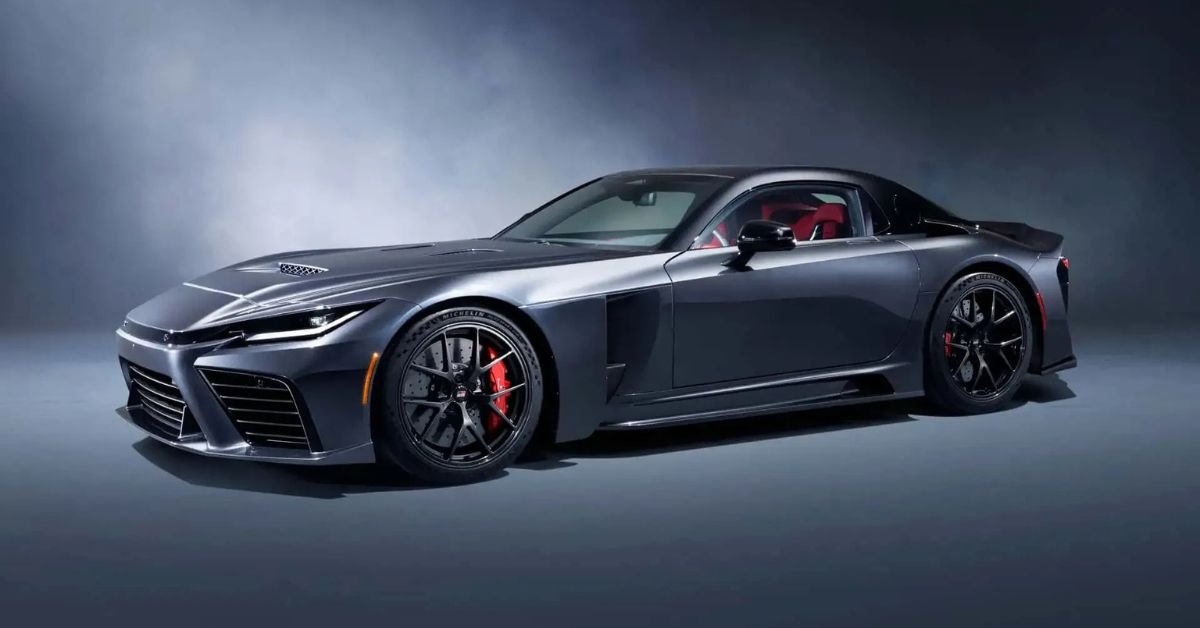
Fifteen years after the Lexus LFA left dealerships, Toyota has finally answered the question every car nut in India has been asking on forums and WhatsApp groups: what’s next? The answer, revealed at the end of 2025, is Toyota’s GR GT a full-blooded, twin-turbo hybrid supercar that has nothing to do with the humble Camry or Fortuner sitting in your neighbour’s driveway.
For Indian buyers, this car will probably never sit in a showroom the way a Fortuner does. But that hasn’t stopped enthusiasts here from tracking every teaser, spec leak, and Nürburgring spy shot. This article breaks down what Toyota’s GR GT actually is, what it’s packing under the hood, and what it realistically means for someone browsing car news from Lucknow, Mumbai, or Bengaluru.
What Exactly Is Toyota’s GR GT?
Toyota’s GR GT is the brand’s new flagship performance car, built under the Gazoo Racing banner as a standalone model rather than a Toyota-badged product in the traditional sense. It’s positioned as the spiritual successor to both the Toyota 2000GT and the Lexus LFA two cars that, decades apart, proved Toyota could build something genuinely special when it wanted to.
Unlike the GR86 or GR Corolla, which are performance versions of everyday cars, the GR GT was designed from a blank sheet as a road-legal race car. It debuted alongside its track-only sibling, the GR GT3, at a special event in Japan in December 2025, before making its first public dynamic demonstration at the Tokyo Auto Salon 2026, where it was seen doing donuts and standing-start sprints in front of a crowd.
Engine, Power, and Performance Numbers
Here’s where things get genuinely exciting. Toyota’s GR GT uses a newly developed 4.0-litre twin-turbocharged V8, paired with a single electric motor built into the transmission for a hybrid boost. Combined system output is targeted at around 641 horsepower roughly 650 PS and close to 850 Nm of torque, sent to the rear wheels alone through a new eight-speed automatic gearbox.
That output places Toyota’s GR GT in direct territory with cars like the Porsche 911 Turbo S and the Mercedes-AMG GT both of which, incidentally, Toyota engineers have openly named as benchmarks during development and testing. To keep weight in check, the car rides on Toyota’s first-ever all-aluminium chassis, with a carbon-fibre bonnet and roof helping trim mass further. Kerb weight is expected to land around 1,750 kg, which is respectable for a hybrid V8 supercar of this size.
Design: Function Over Flash
Photos and videos of Toyota’s GR GT show a low, wide-hipped coupe with a long bonnet and a rear-biased cabin a silhouette that several reviewers have compared to the Dodge Viper. That’s not a coincidence. Toyota’s stated design philosophy for this car prioritises a low centre of gravity, aerodynamic efficiency, and structural rigidity over showroom drama, even though the end result is undeniably dramatic to look at.
The racing-derived GR GT3 variant, built for FIA GT3-spec competition and eventually the World Endurance Championship, shares the same core structure but adds aggressive aero elements larger splitters, a fixed rear wing, and wider fenders for serious downforce on track.
Will Toyota’s GR GT Come to India?
This is the question every enthusiast actually wants answered, and the honest answer is: almost certainly not through official channels at least not initially. Toyota’s GR GT is being positioned as an ultra-low-volume flagship, expected to be sold through select Lexus dealerships internationally rather than regular Toyota showrooms. Toyota hasn’t announced India as a launch market, and given the country’s steep import duties on fully-built vehicles which can run well above 100% of the car’s value, any GR GT reaching Indian roads would likely arrive through the grey import route, the same way a handful of Nissan GT-Rs and Porsche 911 GT3s have made it here.
What Would Toyota’s GR GT Cost in India?
Toyota hasn’t confirmed official pricing anywhere yet, but company executives have pointed to existing GT3-class supercars as the reference point cars like the Porsche 911 GT3, which starts above ₹1.9 crore even before import costs in most markets outside India. Based on that benchmark, an internationally-priced Toyota GR GT would likely start somewhere in the ₹1.6–2 crore range before taxes.
If a unit were ever privately imported into India, expect that number to balloon significantly once you factor in customs duty, GST, and registration costs realistically pushing well past the ₹3.5–4 crore mark, in line with what similar imported supercars fetch here today. These are estimates based on comparable cars, not confirmed figures, since Toyota has not released official pricing for any market.
Why This Car Still Matters to Indian Enthusiasts
Even without a realistic path to Indian showrooms, Toyota’s GR GT matters for a simple reason: it signals that Toyota a brand best known here for reliability, resale value, and the humble Innova is still willing to build something purely for driving joy. That halo effect trickles down. It’s the same energy that made the GR Corolla and GR Yaris both absent from India but massively popular online among enthusiasts build such a devoted following here despite never being sold locally.
For dealerships, YouTubers, and automotive content creators in India, cars like this generate genuine engagement even without a sales angle people want to understand the engineering, compare it to rivals, and dream a little.
Quick Specs Summary
- Engine: 4.0L twin-turbo V8 with single-motor hybrid assist
- Power: ~641 hp / ~650 PS combined
- Torque: ~850 Nm combined
- Transmission: 8-speed automatic, rear-wheel drive
- Chassis: All-aluminium frame with carbon-fibre panels
- Kerb weight: ~1,750 kg
- Production start: 2027 planned
- India availability: Not officially confirmed; import-only expected
FAQ
What is Toyota’s GR GT?
It’s Toyota’s new flagship supercar, built by the Gazoo Racing division as a road-legal successor to the Lexus LFA, powered by a hybrid twin-turbo V8.
How much horsepower does Toyota’s GR GT have?
Toyota is targeting a combined output of around 641 horsepower and roughly 850 Nm of torque from its hybrid V8 powertrain.
Will Toyota’s GR GT be sold in India?
There’s no official confirmation of an Indian launch. Given its ultra-low-volume positioning and steep import duties, it would most likely reach India only through private imports.
What is the expected price of Toyota’s GR GT in India?
Based on comparable GT3-class supercars used as Toyota’s own benchmark, expect an international starting price north of ₹1.6 crore, with imported units in India likely crossing ₹3.5–4 crore after duties.
When will Toyota’s GR GT go on sale?
Production is currently planned to begin around 2027, with the car sold through select Lexus dealerships rather than standard Toyota outlets.
Conclusion
Toyota’s GR GT represents something the brand hasn’t offered in years a no-compromise, engineering-first supercar built to prove that Toyota can still go toe-to-toe with the best from Stuttgart and Affalterbach. With a hybrid twin-turbo V8, a from-scratch aluminium chassis, and genuine motorsport DNA via its GR GT3 sibling, it’s shaping up to be one of the most significant halo cars of the decade. For Indian enthusiasts, official showroom access remains unlikely in the near term, and pricing while unconfirmed will almost certainly land in supercar territory once imports and duties are factored in. Still, as a symbol of what Toyota is capable of beyond dependable family cars, Toyota’s GR GT is worth watching closely as more details emerge ahead of its 2027 production start.
Read More:-